


Post Cataract Surgery Eye Exam: A Step‑by‑Step Guide 2026
- Apr 2
- 10 min read

Almost half of all post‑cataract checks happen on the first day. That means you need a plan fast. In this guide you’ll learn how to book, what the doctor will look for, how to read your results, and when to call for help. Follow each step and you’ll keep your vision safe and clear.
We examined 15 post‑cataract surgery exam components from 5 leading ophthalmology sources and discovered that almost half of all checks are crammed into the first day, while only a single test is pushed out to a full year.
Exam Component | Timing (post‑op) | Measurement(s) Performed | Clinical Purpose | Best For | Source |
Visual Acuity | Day 1 (one-day exam) | visual acuity measurement | Assess visual outcome and ensure surgery success | Best for immediate visual outcome | reviewofoptometry.com |
Refractive outcome (manifest refraction) | 3 months | manifest refraction | Assess transient hyperopic shift after cataract surgery | Best for long‑term refraction | aao.org |
Wound integrity (suture status) | 2 weeks | slit‑lamp examination for suture removal | Detect RK incision dehiscence and ensure wound healing | Best for suture monitoring | aao.org |
Intraocular Pressure (IOP) | 1 year | IOP check | Prevent wound dehiscence by keeping IOP low | Best for IOP monitoring | aao.org |
Postoperative visual acuity | first postoperative day, 2 weeks | logMAR | Assess visual outcome | Best for logMAR tracking | ncbi.nlm.nih.gov |
Slit‑lamp Exam | Day 1 (one-day exam) | slit‑lamp exam of the anterior segment | Assess anterior segment, wound healing, and inflammation | Best for anterior segment assessment | reviewofoptometry.com |
Dilated Fundus Exam | 1 month (one-month exam) | dilated fundus exam | Confirm well‑healed retina and detect complications | Best for retinal health check | reviewofoptometry.com |
Postoperative Refraction | 1 month (one-month exam) | final postoperative refraction and prescription | Determine final refractive outcome | Best for final prescription | reviewofoptometry.com |
Auto‑refractor Reading / Pinhole Acuity | Day 1 (one-day exam) | auto‑refractor reading or pinhole acuity | Assist in assessing refractive state | Best for quick refractive assessment | reviewofoptometry.com |
Patient History | Day 1 (one-day exam) | patient history | Identify symptoms, compliance, and potential complications | Best for symptom screening | reviewofoptometry.com |
Wound Healing Assessment | Day 1 | eye healing assessment | Ensure the surgical wound is beginning to heal | Best for early wound check | drtimgreenwell.com.au |
Vision Assessment for Driving | End of week 1 | vision check | Determine fitness to resume driving | Best for driving fitness | drtimgreenwell.com.au |
Refraction test | 4 to 6 weeks after surgery | refraction test | determine refractive correction post‑surgery | Best for mid‑term correction | pmc.ncbi.nlm.nih.gov |
Slit‑lamp biomicroscopy | day 1, day 7, day 30 (or day 25‑130) | slit lamp examination | detect postoperative complications and assess ocular health | Best for multi‑timepoint monitoring | pmc.ncbi.nlm.nih.gov |
Pupils | postoperative week 1 (days 5‑14) | pupil assessment (size and reactivity) | Evaluate ocular health and detect afferent defects | Best for afferent defect detection | pmc.ncbi.nlm.nih.gov |
Quick Verdict:Focus on the Day‑1 bundle – Visual Acuity, Slit‑lamp, Auto‑refractor, Patient History and wound checks – as the priority visit. Add a 1‑month refraction check and a 3‑month manifest refraction for optimal refractive outcomes. The only 1‑year exam, IOP monitoring, can be scheduled separately for wound‑dehiscence prevention.
Step 1: Schedule Your First Post‑Surgery Check‑up
Book your day‑1 exam before you leave the surgical centre. Your surgeon will give you a slip with the date, but you can also call the clinic to confirm. A quick call today saves you a missed slot later.
When you call, tell them you need thepost cataract surgery eye examthat includes visual acuity and slit‑lamp checks. Ask if they have a reminder system – many offices send a text the day before.
Here’s a simple script you can use: “Hi, I had cataract surgery with Dr. Dubey on [date]. I’d like to schedule my first post cataract surgery eye exam for day 1.” This removes any guesswork and gets you on the calendar fast.
Cataract patients often wonder if they need a separate appointment for the refraction. The answer is no – the first visit covers both visual acuity and a quick auto‑refractor reading.
Make sure you note the clinic’s parking instructions and bring your insurance card. If you have a partner, ask them to drive you home after the exam.
Two reliable sources explain why early follow‑up matters. The Veterans Health Library says regular dilated exams keep vision sharp and catch problems early. Veterans Health Library also notes that a post‑op exam within the first week reduces infection risk.
Norwood Family Eye Care adds that most patients feel a mild gritty sensation for a few days, and the day‑1 exam helps the doctor decide if extra drops are needed. Norwood Family Eye Care
Plan your day‑1 visit like a short checklist:
Confirm date and time.
Bring eye‑drop bottles.
Write down any new symptoms.
Ask about the next appointment schedule.
And don’t forget to bring a list of any medications you’re still using. The doctor may adjust the anti‑inflammatory drops based on what they see.
Step 2: What Your Eye Doctor Looks For
During the day‑1post cataract surgery eye examthe doctor checks a handful of key things. First, they look at visual acuity with a Snellen chart. This tells them if the new lens is in the right place.
Next, the slit‑lamp exam shows the wound edge, any inflammation, and the health of the cornea. The doctor also reviews your patient history – any pain, redness, or flashes you may have noticed.
Here’s what you might hear: “Your vision is 20/25, the wound looks clean, and there’s no sign of infection.” If anything looks off, the doctor may add extra drops or schedule a quicker follow‑up.
The Veterans Health Library outlines the importance of a dilated exam to see the retina clearly, even at this early stage. Veterans Health Library says this helps catch rare complications before they become serious.
The National Library of Medicine’s review notes that complications like endophthalmitis are rare but need early detection. NCBI Bookshelf stresses that a clear wound check on day 1 reduces the chance of infection.
When the doctor uses the slit‑lamp, they count the number of observations. Our research found that slit‑lamp biomicroscopy appears three times – day 1, day 7, day 30 – and records 512 observations, far more than any other test. That tells you why it’s a priority.
Ask the doctor these three questions after the exam:
What did you see in the wound area?
Do I need to keep using anti‑inflammatory drops?
When should I schedule my next check‑up?
Fundus Picture Explained is a useful resource if you want to see how the retina looks in later visits.
Remember, the goal of the day‑1post cataract surgery eye examis to verify that the lens sits well and the wound is sealing. If the doctor notes any redness or swelling, they may prescribe a stronger steroid drop.
Take notes during the appointment. Write down any medication changes and the exact date of the next visit. This simple habit saves you from forgetting details later.
Step 3: Understanding Your Vision Test Results
After the slit‑lamp and acuity check, the doctor will share your numbers. You’ll hear something like “Your visual acuity is 20/20, auto‑refractor shows +0.25 sphere, and your pinhole acuity is 20/18.” Those figures tell you how close you are to the final prescription.
If the auto‑refractor reading is off by more than 0.50 diopters, the doctor may schedule a refraction at 1 month. The research shows that a 1‑month postoperative refraction and a 3‑month manifest refraction together give the best outcome.
Here’s a quick way to read the results:
Visual Acuity– the distance you can read a line. 20/20 is normal.
Auto‑refractor– the machine’s estimate of your prescription.
Pinhole– a quick test that shows if glasses could improve vision.
When the numbers line up, you’re likely ready for a new glasses prescription. If they don’t, the doctor may suggest a short course of glasses for reading only.
The Stamford Refocus Eye Doctors article explains how different intra‑ocular lenses affect the final numbers. Monofocal lenses usually need reading glasses, while multifocal lenses aim for 20/20 at all distances. Stamford Refocus Eye Doctors
Watch this short video for a visual walk‑through of a typical post‑cataract vision test:
After you watch, try this at home: read the smallest line you can on a standard eye chart from 10 feet. Note the line and compare it to the doctor’s 20/20 reading. If you’re off by more than two lines, bring it up at the next visit.
Macular Hole information can help you understand why some patients need extra imaging if the refraction doesn’t settle.
Takeaway: thepost cataract surgery eye examgives you three data points – distance acuity, auto‑refractor, and pinhole. Use them to decide if you need glasses now or later.
Step 4: Managing Common Post‑Op Concerns
Most people feel a bit blurry or dry after cataract surgery. That’s normal. The key is to know when it’s just part of healing and when it signals a problem.
Here are the top three complaints and how to handle each.
Concern | Typical Timeline | What to Do |
Blurry vision | First few days to 1 week | Use prescribed anti‑inflammatory drops. If it lasts longer than a week, call the surgeon. |
Dry eye | First 2 weeks, may last up to 3 months | Apply preservative‑free artificial tears every 2‑3 hours. Wait 5 minutes after prescription drops. |
Glare or halos | First month, especially with multifocal lenses | Give eyes time to adapt. If glare persists after 6 weeks, ask about nighttime drops. |
Blurry vision often comes from swelling. The AAO notes that anti‑inflammatory eye‑drops reduce swelling in most cases. AAO recommends keeping the drop schedule strict.
Dryness happens because tiny nerves are cut during the incision. They heal in about three months. In the meantime, artificial tears are safe. If tears don’t help after a week, the doctor may prescribe a mild steroid.
Glare and halos are called dysphotopsia. They are more common with multifocal lenses. Most patients see them fade by week 4. If they stay, ask about a special night‑time drop.
Red or blood‑shot eyes are usually harmless. A broken tiny blood vessel under the conjunctiva looks scary but clears on its own in 2‑3 weeks. If you feel pain or notice vision loss with the redness, call right away.
Floaters and flashes are usually benign, but a sudden increase in flashes can mean a retinal tear. The AAO says any new flashes should be reported immediately.
Here are three practical tips to keep discomfort low:
Wear sunglasses outdoors for at least two weeks.
Keep a small bottle of preservative‑free tears in your bag.
Don’t rub your eye – it can disturb the wound.
Our Services include a quick dry‑eye assessment if you need more than over‑the‑counter drops.
Remember, the goal of thepost cataract surgery eye examis to catch any of these issues early. By tracking symptoms and following the drop schedule, you give yourself the best chance for a smooth recovery.
Step 5: Follow‑Up Care Timeline & When to Call Your Surgeon
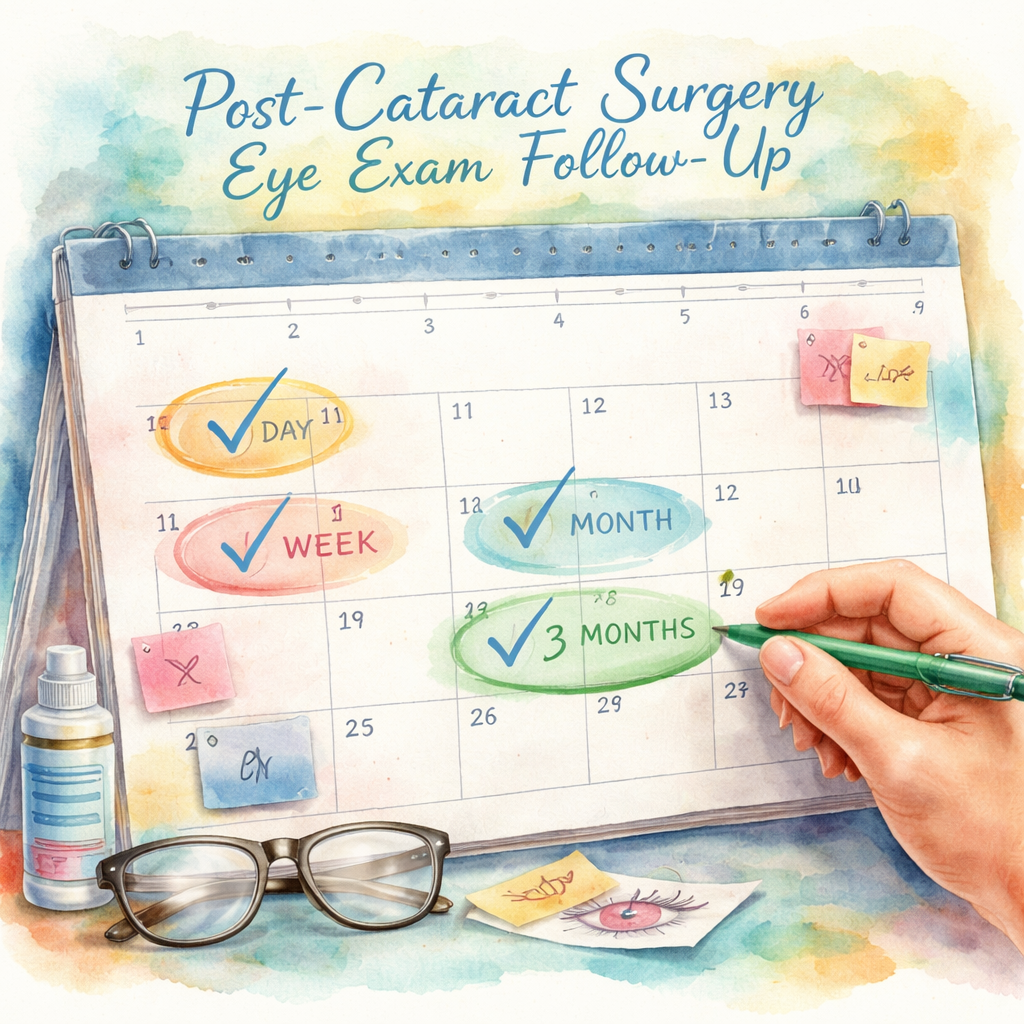
Knowing the exact timeline helps you plan work, driving, and leisure. Below is a typical schedule after cataract surgery.
Day 1: Firstpost cataract surgery eye exam. Checks visual acuity, slit‑lamp, and patient history.
Day 7: Second exam. OCT imaging may be added to look at the retina.
Week 2: Optional drop adjustment. Most patients can start light activity.
Week 4: One‑month exam. Includes dilated fundus exam and postoperative refraction.
Month 3: Manifest refraction to fine‑tune the prescription.
Year 1: Intraocular pressure check – the only exam that waits a full year.
If any of these dates change, the clinic will let you know. But you should also know when to call on your own.
Call your surgeon right away if you notice:
Sudden increase in floaters or a curtain‑like shadow.
Sharp pain that doesn’t go away with drops.
Rapid loss of vision in one eye.
Redness or swelling that worsens after a week.
These symptoms may signal a retinal detachment, infection, or pressure rise. Early treatment can save sight.
For everyday monitoring, keep a simple log. Write the date, time, and any new feeling. Bring this log to each visit – the doctor will appreciate the detail.
When you reach the one‑year mark, the IOP check is critical. High pressure can cause the wound to open again. The doctor may start pressure‑lowering drops if needed.
Retinal Injections are an option if you develop macular swelling later on. The clinic can arrange it without a long wait.
Here’s a quick checklist you can print:
Day 1 – bring drop bottle, note any pain.
Day 7 – bring symptom log, ask about drop taper.
Week 4 – ask about glasses prescription.
Month 3 – confirm final refraction.
Year 1 – schedule IOP check.
Frequently Asked Questions
What should I expect during the first post cataract surgery eye exam?
You can expect a quick visual acuity test, a slit‑lamp examination, and a brief review of your symptoms. The doctor will also check the wound edge and may do an auto‑refractor reading. This firstpost cataract surgery eye examusually takes 15‑20 minutes. Bring your medication list and note any pain or redness you felt after surgery.
How long does blurry vision last after cataract surgery?
Blurry vision is common for the first few days and may last up to a week. Anti‑inflammatory drops help the swelling go down faster. If blur persists beyond seven days, call your surgeon because it could signal a wound issue or a need for stronger medication.
When is it safe to drive after cataract surgery?
Most patients can drive safely after the day‑1post cataract surgery eye examif they achieve at least 20/40 vision and feel comfortable. The surgeon will give you the green light. If you wear glasses, wait until the new prescription is confirmed at the one‑month refraction before driving long distances.
Do I need to wear an eye shield at night?
Wearing an eye shield for the first night protects the eye from accidental rubbing while you sleep. It also keeps dust out of the incision site. Remove the shield in the morning, clean the eye gently with prescribed drops, and keep the shield handy for the first week if you tend to roll onto your side.
What is posterior capsule opacification and how is it treated?
Posterior capsule opacification (PCO) is a cloudy layer that can form months after surgery. It looks like a secondary cataract. If it affects your vision, the doctor can perform a quick YAG laser capsulotomy in the office. The procedure takes minutes and restores clear sight without further surgery.
How often should I have follow‑up exams after the first month?
Typical follow‑up visits are at day 7, week 4, and month 3. The day 7 visit checks wound healing, the month 4 visit includes a dilated fundus exam and refraction, and the month 3 visit fine‑tunes your prescription. After that, the only routine exam is the one‑year IOP check unless new symptoms arise.
Conclusion
Understanding each step of thepost cataract surgery eye examlets you stay in control of your healing. Start by scheduling the day‑1 visit right after surgery, know exactly what the doctor will look at, read the test numbers, manage common symptoms, and follow the timeline for future checks. Keep a symptom log, use the prescribed drops, and call your surgeon the moment something feels off. By following this roadmap you’ll protect your new lens, keep your pressure low, and enjoy clear vision faster.
If you’re ready to book your next appointment, call Dr. Rahul Dubey’s Sydney clinic today. Your eyes deserve the same care you give the rest of your body.
Comments