


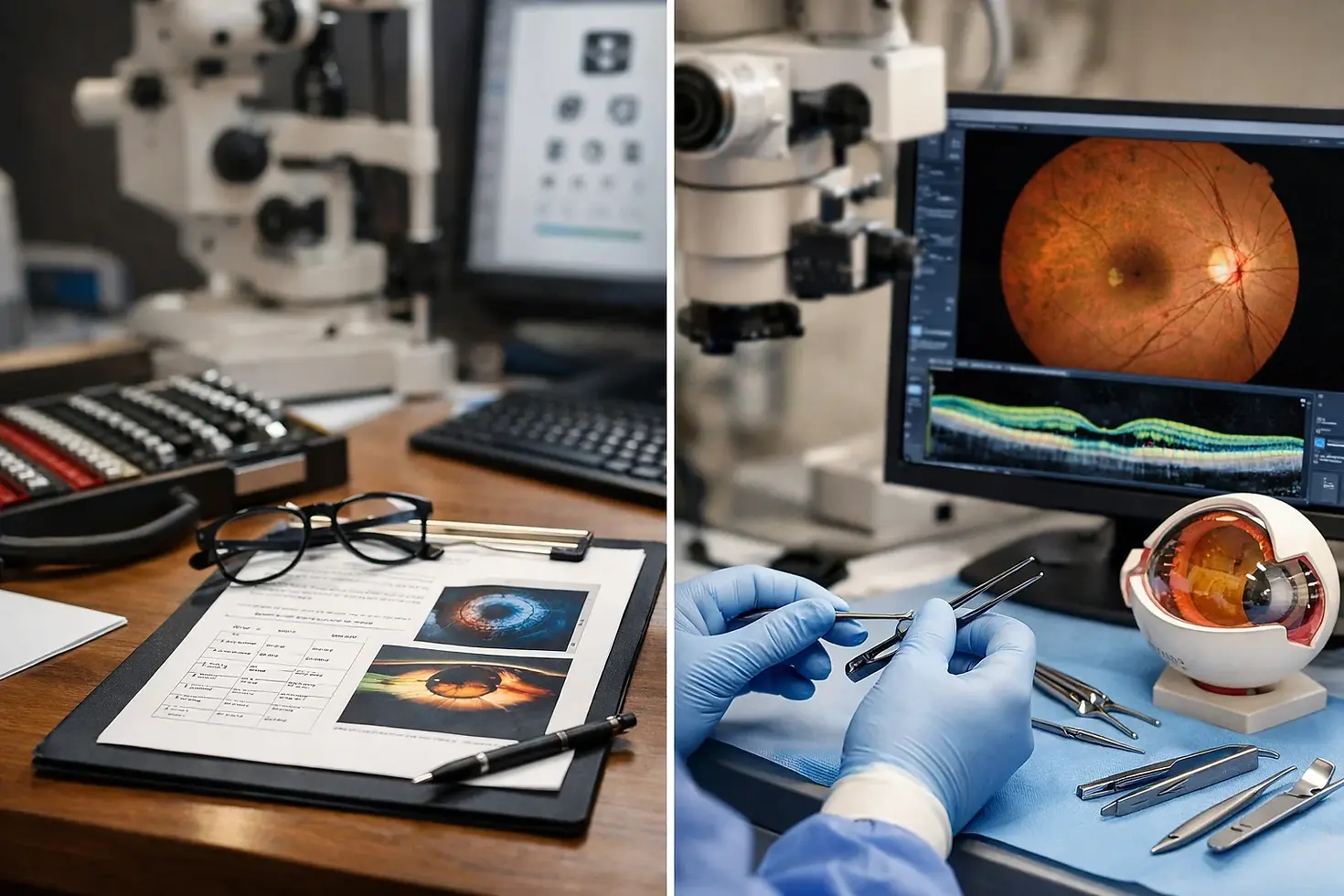
Optometrist vs Ophthalmologist: Which Wins?
- 2 days ago
- 7 min read
Table of Contents
At 8:10 on a cold Tuesday, the check-in desk at a rural clinic is already busy. A patient with worsening blurry vision stands there holding two appointment cards — one for the local eye clinic next week, one for a regional specialist three towns away.
The optometrist versus ophthalmologist question feels simple until you are the one making it. If you live outside a major city, the choice affects travel, timing, referrals, and sometimes how quickly a cataract, retinal problem, or other serious eye condition is treated.
You do not need a slogan. You need a clear decision path.
What are we comparing in an optometrist versus ophthalmologist decision?
The two jobs in plain English
Both professionals help maintain and improve sight, whether you are 17 and squinting at a classroom board or 72 and struggling with road signs at dusk. That is the shared ground. The split appears when you ask what kind of problem is actually on the table.
An optometrist is commonly described as the primary eye-care doctor for your eyes: routine exams, vision testing, prescriptions, and first-line assessment. An ophthalmologist works in the medical and surgical lane, managing eye disease and performing procedures when treatment moves beyond routine care.
Why the choice matters for complex eye disease
If your issue is a glasses prescription, a local optometrist is often the right first booking. If the concern is cataract, retinal disease, diabetic eye damage, or anything that may require laser, injections, or surgery, delay can create risk — especially when access in rural and regional areas already involves extra travel.
We see this distinction matter every week in referral pathways. A gradual prescription change and a macular hole can both begin with the words “my vision is blurry,” but they do not belong in the same care pathway.
A fast way to think about the decision
Ask one question: is this mostly about seeing better, or is it about eye disease that may need medical or surgical treatment? If it is the first, optometry usually makes sense. If it is the second, ophthalmology should move to the front.
Rule of thumb: choose based on the problem, not just whichever appointment opens first.
Overview of an optometrist
Routine eye exams and vision testing
Optometrists provide routine eye exams and vision tests. That includes checking how clearly you see at distance and near, measuring refractive change, assessing how your eyes work together, and reviewing general eye health during a standard visit.
For many people, this is the correct front door into eye care. If you are due for a yearly check, have headaches after long days on a laptop, or notice gradual blur while driving at night, this is where you usually start.
Glasses, contacts, and common eye conditions
Optometrists prescribe eyeglasses and contact lenses. They also diagnose and treat many common eye conditions and can detect early signs of more serious disease. In practical terms, that means they often help with routine prescription needs, dry eye, and other day-to-day problems while keeping watch for cataract change, glaucoma risk, or retinal findings that need referral.
That role matters in smaller towns. Your local optometrist may be the clinician who first spots bleeding from diabetes, swelling at the back of the eye, or a cataract that has moved from minor nuisance to a real safety issue.
Training and scope of practice
Major patient education sources commonly describe optometrists as completing four years of professional optometry training after college to earn a Doctor of Optometry, or O.D., degree. Training titles and scope rules vary a little by country and jurisdiction, including across Australia, but the practical point for you remains steady: optometry is designed for primary eye care, vision correction, routine monitoring, and first-line triage.
That is why referral pathways work well when they work early. An optometrist does not lose by referring you on. Good care depends on recognising when the next level is needed.
Think of an optometrist as the first stop for vision correction and routine eye-health checks.
Overview of an ophthalmologist
Medical and surgical eye care
Ophthalmologists treat medical and surgical issues with the eyes. That distinction is decisive. When the problem involves cataract, retinal disease, significant inflammation, trauma, or anything likely to need a procedure, you are in ophthalmology territory.
This is the lane for diagnosis plus intervention. In real terms, that may mean laser treatment, operating theatre decisions, intravitreal injections, or surgery for a retinal detachment rather than a new pair of glasses.
Training pathway and credentials
Standard patient education sources describe ophthalmologists as completing medical school, then a one-year internship and a three-year residency. Australian specialist training is structured differently in naming and oversight, yet the crucial point does not change: an ophthalmologist is a medically trained eye specialist with surgical capability.
That depth matters when the eye problem is part of a wider medical picture. Diabetes, inflammatory disease, age-related eye disease, and cataract assessment often demand more than a refraction and routine monitoring.
Why complex cases often land here
Once surgery enters the conversation, ophthalmology is usually the right destination. The same applies when symptoms worsen quickly, when scans show retinal or macular disease, or when vision loss is not explained by a simple prescription change.
For patients in the Hills District, Canberra, Liverpool, Randwick, and surrounding regional communities, access to ophthalmology is not just about convenience. It is about making sure time-sensitive problems are assessed in the setting where treatment can actually be delivered.
If a procedure may be needed, ophthalmology is the specialist lane.
Optometrist vs. ophthalmologist: side-by-side comparison table
Education and credentials
The training paths are different because the jobs are different. One is built for primary eye care and visual correction. The other is built for medical diagnosis, disease management, and surgery.
Services and procedures
If you want the practical view, compare what each professional is set up to do during an ordinary week in clinic.
Best use case at a glance
The quickest summary is this: optometry covers routine and first-line care, while ophthalmology covers medical and surgical depth. Neither role replaces the other. In a good system, they work in sequence.
The difference is not “better vs. worse” — it is routine care versus medical and surgical depth.
When to choose an optometrist
Need a routine eye exam?
Choose an optometrist when you need a routine check. If it has been 12 months since your last eye exam, if your reading vision has drifted, or if you want screening before problems escalate, optometry is the logical first appointment.
This is especially practical in rural towns, where the local clinic is often easier to reach and can decide quickly whether specialist care is needed.
Need glasses, contacts, or a prescription update?
If your main goal is clearer vision through updated glasses or contact lenses, optometry is designed for exactly that. Nearsightedness, farsightedness, astigmatism, and age-related reading changes are everyday work in this setting.
You will usually get faster answers here than by waiting for a surgical clinic slot that is meant for disease, not refraction.
Need a first pass on common eye symptoms?
Optometrists diagnose and treat common eye conditions and can detect early signs of more serious eye disease. If you have gradual blur, eye strain, mild redness, or discomfort that is not dramatic or sudden, a first-line review is sensible.
Just keep one rule in mind: a first pass is still a triage point. If the examination suggests cataract, retinal change, glaucoma risk, or another deeper issue, referral should happen early, not after several repeat visits.
If your goal is vision correction or a first-line eye check, start with optometry.
When to choose an ophthalmologist
Cataracts and retinal disease
Choose an ophthalmologist when cataracts or retinal disease are already part of the conversation. If night driving has become unsafe, colours look washed out, straight lines look bent, or your central vision has dropped, you may be past the routine-care stage.
This is also the right pathway for diabetic retinopathy, age-related macular disease, retinal tears or detachments, and other conditions where scans, procedures, or surgery may be required rather than a simple prescription change.
Eye pain, blurry vision, or sudden change
Blurry vision is not always routine. If it worsens quickly, comes with eye pain, or appears suddenly, do not wait for the next standard eye-exam opening. You need the level of care that can investigate a medical cause and act on it.
In after-hours or emergency situations, urgent medical assessment may be appropriate. The practical point is simple: sudden change belongs in a faster, higher-acuity pathway than routine optometry.
When surgery or advanced treatment is on the table
Once surgery, laser treatment, injections, or complex medical management are possibilities, ophthalmology becomes the right choice. That includes cataract surgery, retinal procedures, and conditions where delay can reduce the chance of preserving vision.
For patients across the Hills District, Canberra, Liverpool, Randwick, and nearby regional communities, this is the kind of pathway followed when seeing an ophthalmologist such as Dr Rahul Dubey for cataract assessment, retinal disease, or other advanced eye care needs.
If surgery is already part of the conversation, do not wait for a routine eye-exam slot.
Conclusion: which wins?
Quick decision checklist
Here is the clear answer: in the optometrist versus ophthalmologist decision, routine vision care starts with optometry, while medical, surgical, or complex disease belongs in ophthalmology.
Best takeaway: start where your problem fits best, and move fast when the issue looks medical, surgical, or complex.
How to prepare for the visit
Bring your glasses, medication list, previous scans, and a brief timeline of symptoms. In regional areas, ask whether testing and follow-up can be coordinated on one trip.
When to ask for a referral
If blur, pain, cataract symptoms, or retinal concerns are building, ask early rather than waiting through another routine slot. Which appointment best matches what your eye is telling you now?
Comments