


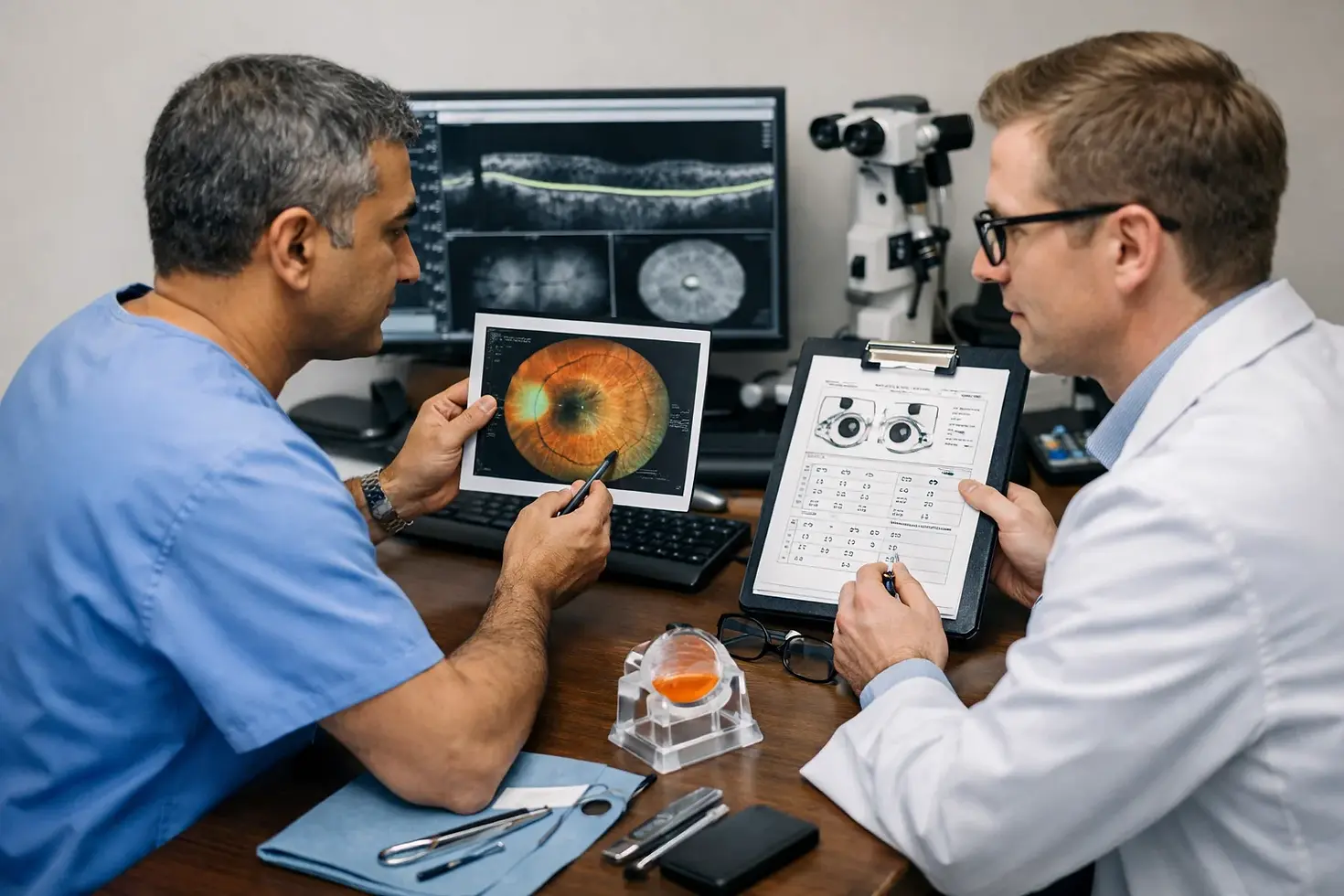
What is the difference between an ophthalmologist and an optometrist
- May 10
- 9 min read
Table of Contents
A patient in a small-town clinic slides a referral note across the desk after a routine eye test and asks, “Do I need an eye doctor or a specialist?” The eyeglass case is still open. The vision chart hangs behind you. What felt like an ordinary appointment has turned into a different kind of decision.
That is usually when what is an ophthalmologist stops being a search term and becomes a practical question about your next step. I have seen this moment often, especially when the issue is not just blurry distance vision but glare at night, new floaters, a cataract diagnosis, or a retinal finding that needs a closer look.
If you live in a rural or regional area, the choice matters even more. A routine glasses review can often happen close to home. A surgical opinion may mean planning travel, taking time off work, and moving quickly if vision is changing. This guide keeps the difference simple: who handles routine vision care, who manages disease, and when you should escalate without delay.
What should you know before deciding who to see?
You should know this first: the difference is not a terminology quiz. It is a care-path decision based on what your eyes may need next.
Why people confuse ophthalmologists and optometrists
The confusion is understandable. Both work in eye care. Both may examine your eyes. Both may be involved before and after treatment. The American Academy of Ophthalmology has a patient guide comparing ophthalmologists, optometrists, and opticians precisely because patients mix these roles up every day. UNC makes the same broader point: all three play a significant role in patient care.
In practice, you usually meet the difference only when the problem changes. If you need a new glasses prescription, contact lens advice, or a routine eye test, the path is straightforward. If the issue points to cataracts, glaucoma, retinal disease, or unexplained vision loss, the conversation changes fast.
Why the answer matters for complex eye disease
Complex eye disease does not wait politely. Cataracts can steadily reduce driving confidence. Glaucoma may progress quietly. Retinal disease can change vision suddenly — sometimes over hours, not weeks. A routine vision check may detect these issues, but detection is not the same as definitive medical or surgical management.
If your symptoms are new, worsening, or hard to explain, you do not want to lose time bouncing between the wrong appointments. For rural patients, that delay can be magnified by distance. One extra round trip from a regional town to Canberra, Liverpool, or Randwick is not minor when you are already dealing with reduced sight.
The simplest rule is this: if the problem may need medicine, procedures, or surgery, you are probably past routine eye care.
How this guide helps you choose the right next step
This guide gives you a practical filter. It will show you what an ophthalmologist does, what an optometrist usually handles, how referrals work, and what to ask when you are told to book a specialist appointment.
You do not need to memorise job titles. You need to know where your condition fits. For most people, that is enough to make a sensible next move.
What is an ophthalmologist?
An ophthalmologist is a physician trained to diagnose, treat, and, when necessary, operate on conditions affecting the eyes and vision.
What training does an ophthalmologist have?
According to Cleveland Clinic, ophthalmologists are doctors of medicine (MD) or doctors of osteopathy (DO). Their training path is long and structured: a four-year undergraduate degree, medical school, a one-year internship, and at least three years of specialised medical and surgical training in eye care.
That sequence matters. It means your ophthalmologist is trained not only to identify a problem but to manage the full medical picture around it — diagnosis, medication, procedures, surgery, recovery, and longer-term follow-up.
What conditions do ophthalmologists diagnose and treat?
Cleveland Clinic states that ophthalmologists can diagnose and treat any issue that affects the eyes or vision. In day-to-day care, that commonly includes cataracts, glaucoma, diabetic eye disease, retinal tears, macular degeneration, inflammation inside the eye, and unexplained changes in sight.
You will often see ophthalmology involved when the stakes are higher: worsening night glare, a drop in central vision, bleeding in the eye, straight lines looking bent, flashes and floaters, or a cataract advanced enough to interfere with reading, driving, or work.
Cleveland Clinic also notes that age-related problems such as cataracts and glaucoma are common reasons for ophthalmology review. That aligns with what we see in clinic. These are not fringe conditions. They are everyday reasons for specialist care.
If the eye problem might need surgery or long-term medical treatment, ophthalmology is the physician specialty to look for.
What can an ophthalmologist do that other eye-care providers may not?
Cleveland Clinic describes three core capabilities that set ophthalmology apart: prescribing medication, recommending vision correction such as glasses or contact lenses, and performing surgery. That final point is the dividing line most patients care about once a diagnosis becomes serious.
An ophthalmologist can assess whether your cataract is ready for surgery, whether a retinal problem needs urgent treatment, whether glaucoma requires procedural care, and whether your symptoms point to a disease rather than a simple change in prescription.
Put plainly, what is an ophthalmologist? It is the eye specialist you see when a routine exam is no longer enough and physician-led treatment is required.
Why does it matter whether you see an optometrist or an ophthalmologist?
It matters because routine vision care and complex eye disease are different jobs. One often starts the process. The other often takes over when diagnosis, treatment, or surgery becomes necessary.
What optometrists typically handle
Humana describes optometrists as providers who perform eye exams and vision tests, detect vision problems, and prescribe corrective treatments such as glasses, contact lenses, and medications. Their education pathway is also distinct: four years of professional training after college to earn a Doctor of Optometry (OD) degree.
That makes optometrists a sensible first stop for many people. They are central to routine vision care, prescription updates, contact lens management, and early detection. If you have not had an eye exam in years, starting locally with an optometrist is often appropriate.
When ophthalmology is the better fit
Humana draws a useful comparison: your optometrist is like the primary care doctor for your eyes, while your ophthalmologist is more like the specialist. Cleveland Clinic is more direct — ophthalmologists treat medical and surgical eye problems.
If you already know you have cataracts, glaucoma, a retinal diagnosis, diabetic eye disease, or unexplained vision changes, you are usually in ophthalmology territory. The same applies if your optometrist has found something abnormal on imaging or examination and has advised referral.
Routine vision correction is not the same job as treating eye disease: glasses and contacts may be handled locally, but cataracts, glaucoma, and surgical problems belong with ophthalmology.
Why rural patients need to think about referral timing
If you live in a regional community, timing is not a minor detail. It affects travel, family support, driving arrangements, and how quickly treatment can be started. A referral for cataract surgery may allow some planning. A referral for a retinal problem may not.
My practical advice is simple: when your local optometrist recommends ophthalmology, ask three questions before you leave the room. How urgent is this? What problem are you concerned about? Do I need to avoid waiting several weeks? Those three questions can spare you a dangerous delay.
For patients in and around the Hills District, Canberra, Liverpool, Randwick, or outlying rural towns, early referral can be the difference between organised treatment and an avoidable rush later.
How does eye care usually work when the problem is more complex?
In most communities, eye care works as a handoff system. You start locally when appropriate, then move to ophthalmology when testing suggests disease, a procedure, or fast-changing symptoms.
What usually happens at the optometrist first
Humana notes that optometrists detect vision problems and can prescribe some medications. That makes them a common first point of contact. A local exam may include vision testing, refraction for glasses, eye pressure measurement, and a close look at the front and back of the eye.
If the findings suggest a cataract that is starting to affect function, suspicious optic nerve change, diabetic retinal damage, or unexplained reduced vision, the next step is usually referral. That is not a failure of the first visit. It is the intended pathway.
What happens after a referral to ophthalmology
Once you reach ophthalmology, the visit is narrower and deeper. Cleveland Clinic states that ophthalmologists can diagnose and treat any issue affecting the eyes or vision and can perform surgery. So the consultation usually focuses on confirming the diagnosis, measuring severity, discussing treatment options, and deciding whether medication, monitoring, laser treatment, injections, or surgery is needed.
If you are being assessed for cataracts, the discussion may cover how much the cataract is affecting daily life, whether surgery is appropriate now, and what lens choices fit your needs. If the concern is retinal disease, the pace may be faster. Some retinal conditions need urgent treatment to protect sight.
A referral is not a dead end; it is the normal handoff when the problem has moved beyond routine vision care.
How both providers can work together
UNC notes that ophthalmologists, optometrists, and opticians all play significant roles in patient care. That point deserves emphasis. Good eye care is often shared care.
Your optometrist may detect the problem, document the change, and send the referral. Your ophthalmologist may confirm the diagnosis, manage treatment, or perform surgery. After that, ongoing reviews may be shared depending on the condition. This is common after cataract surgery, in stable glaucoma care, and in longer-term monitoring after treatment.
For rural and regional patients, this combined model is especially valuable. It keeps routine reviews close to home while reserving specialist travel for visits that genuinely require it.
Start locally for routine vision checks or early symptoms when safe.
Escalate quickly if testing suggests disease, surgery, or sudden change.
Ask who will manage each part of your care after referral.
What are the most common questions about ophthalmologists and optometrists?
Most people ask the same few questions once a referral lands in their hand. The answers are usually straightforward.
Is an ophthalmologist the same as an eye surgeon?
Not exactly, but surgery is part of ophthalmology. Cleveland Clinic states that ophthalmologists can perform surgery. So every eye surgeon is an ophthalmologist, but not every ophthalmology appointment is a surgery appointment.
Some ophthalmologists focus heavily on medical management. Others concentrate on cataract surgery, retina, glaucoma, cornea, or another subspecialty. If a procedure is being discussed, ask whether the ophthalmologist who assesses you will also perform it, and whether any subspecialty expertise is relevant to your condition.
Can an optometrist diagnose eye disease?
Yes — often they are the first to detect it. Humana notes that optometrists detect vision problems and can prescribe glasses, contact lenses, and some medications. That means an optometrist may be the person who first identifies suspicious pressure, a cataract, diabetic changes, or retinal abnormalities.
What they do not do is replace ophthalmology when the condition needs surgical care or physician-led management over time. Detection and referral are essential clinical work. They are simply not the same as specialist treatment.
Should I book ophthalmology for cataracts or retinal problems?
Yes. Cleveland Clinic lists cataracts as a common reason to see an ophthalmologist. Retinal conditions are also generally specialist problems. They often need detailed diagnosis, medical treatment, laser treatment, injections, or surgery — sometimes urgently.
If you have been told you have a cataract, glaucoma, a macular issue, diabetic retinopathy, a retinal tear, or unexplained visual distortion, book ophthalmology rather than waiting for another routine prescription review. The earlier the assessment, the clearer your options will be.
If you have cataracts, glaucoma, or a retinal diagnosis, ask who will manage the condition and who will do any procedure before you book.
A final practical note: if you are booking from a rural town, tell the specialist rooms what diagnosis was mentioned, who referred you, and whether your vision is changing now. That helps the team judge urgency properly and may shorten the wait to the right appointment.
Here is the practical answer: optometrists handle routine vision care and early detection, while what is an ophthalmologist means the physician you need for complex disease, cataracts, retinal problems, and surgery.
Start locally when the problem seems routine. Escalate quickly when symptoms change, a diagnosis becomes serious, or a procedure may be required. What has your eye test — or your symptoms — already told you about which path you are really on?
Comments