


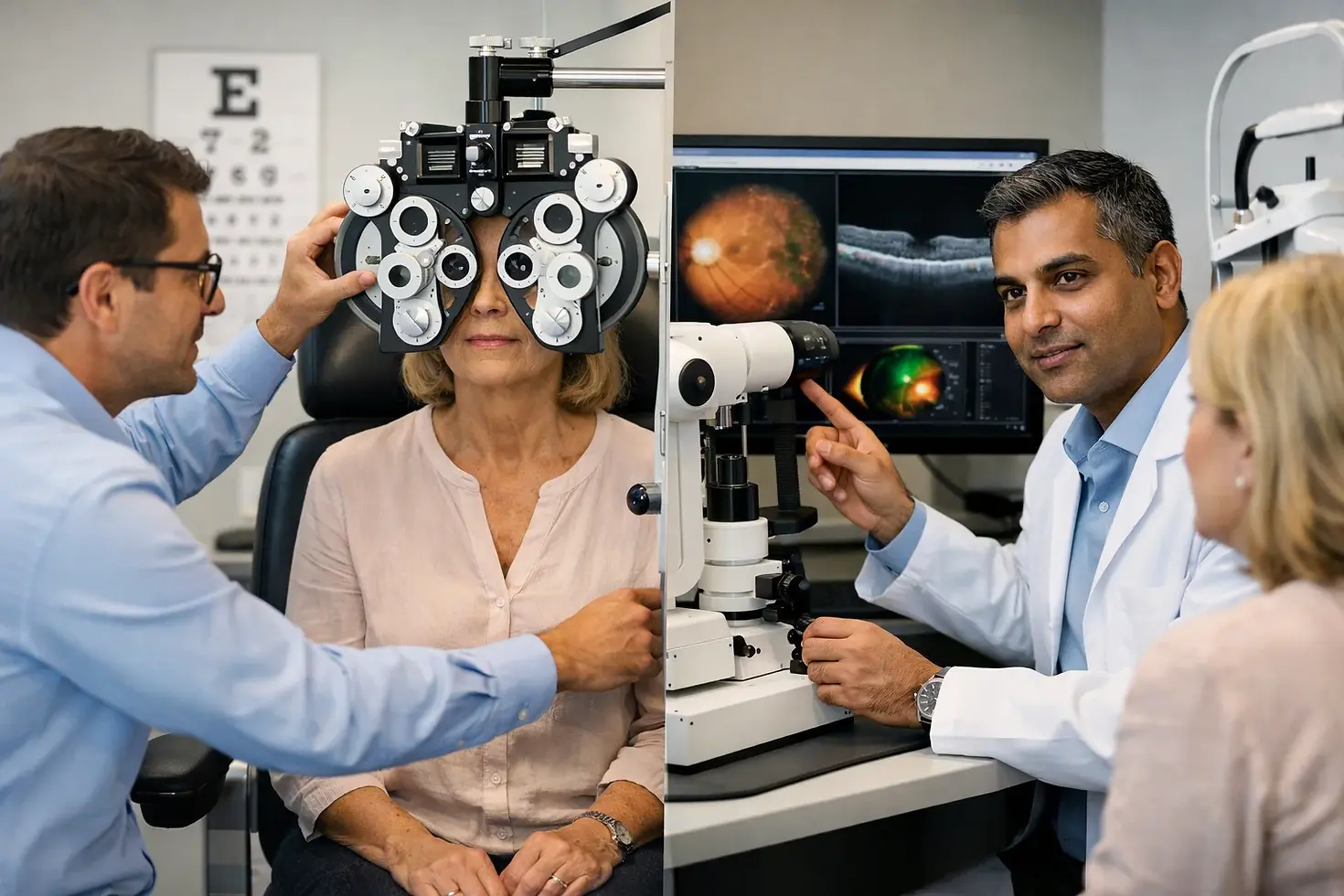
Is it better to go to an optometrist or ophthalmologist
- 1 day ago
- 9 min read
Table of Contents
The referral slip is folded twice. In a small clinic outside Bathurst, a patient has just heard the word “cataract,” and before the chair is even pushed back, the real question arrives: should the next booking be with the local optometrist, or with the ophthalmologist two hours away?
If you are searching for what is the difference between a optometrist and an ophthalmologist, you usually do not want a textbook definition. You want to know who can help first, who can treat disease, and who can operate if your sight is starting to narrow, blur, or disappear. In regional NSW, Canberra, or any town where travel is a factor, that distinction matters quickly.
The short answer is practical. Optometrists are usually the front door for routine vision care, screening, glasses, contact lenses, and early detection. Ophthalmologists are medical and surgical eye specialists. When cataracts, retinal disease, injections, laser treatment, or surgery may be part of the plan, ophthalmology is generally the right level of care.
What an Optometrist Does
Training and credentials
An optometrist is your first-line eye care clinician. In widely used public guides, the training path is described as four years of professional study after college to earn a Doctor of Optometry, or OD, degree. Exact qualification names vary across countries, but the role is consistent: primary eye care, vision assessment, and early identification of problems that may need higher-level treatment.
Think of an optometrist as the primary care doctor for your eyes.
That framing is useful because it matches how most patients actually enter the system. In towns such as Orange or Goulburn, your local optometrist is often the easiest appointment to secure, the closest clinic to reach, and the place where changes are first noticed.
Routine services they provide
Routine work sits squarely in optometry. That includes full eye exams, vision testing, prescription checks, glasses, contact lenses, and evaluation of common day-to-day complaints. Blurry distance vision, reading strain, headaches linked to focusing, contact lens discomfort, and many dry-eye or allergy-related symptoms are usually assessed here first.
Optometrists also prescribe corrective treatment and, depending on local scope rules, some medications for common eye conditions. If your issue is ordinary but bothersome, optometry is often the efficient start.
Routine eye examinations
Vision testing for driving, reading, and work
Glasses and contact lens prescriptions
Monitoring of common eye complaints such as dry eye or mild irritation
Ongoing checks for people with diabetes, family eye disease history, or age-related vision change
What an optometrist can detect and refer
This is where optometry becomes especially valuable. A good optometrist does not just measure how well you read an eye chart. Early cataracts, suspicious optic nerve changes, diabetic eye damage, macular degeneration, and signs of retinal trouble may all be picked up during a routine assessment. That matters because many serious eye conditions begin quietly.
A patient in Dubbo may arrive asking for stronger glasses and leave with a referral for cataract surgery assessment. Another in Wagga Wagga may report new floaters and be sent the same day for specialist review. That is not a failure of optometry. It is exactly how the system should work.
When the problem crosses into disease management, procedures, or surgery, the optometrist’s role shifts from first-line care to detection, referral, and often ongoing shared follow-up.
What an Ophthalmologist Does
Medical training path
An ophthalmologist is a medically trained eye specialist. Public-facing guides commonly describe the pathway as medical school, followed by a one-year internship and a three-year residency in ophthalmology. Country-specific training structures differ, but the decisive point does not change: this is the clinician equipped to diagnose and manage medical eye disease and to perform eye surgery.
If surgery is likely, the ophthalmologist is usually the right starting point.
That distinction becomes critical once the issue is more than a prescription problem. If you have been told you have cataracts, a retinal condition, or a disease that may damage the eye itself, you are moving beyond routine primary eye care.
Medical and surgical scope
Ophthalmology covers medical and surgical problems of the eye. That scope includes diagnosis, medication management, laser procedures, injections, and operations. Not every ophthalmologist performs every kind of procedure — many subspecialise — but the field as a whole is where complex eye treatment sits.
Typical ophthalmology work includes cataract assessment and surgery, retinal disease treatment, management of age-related macular degeneration, diabetic eye disease care, surgery for retinal detachment, and evaluation of sudden or severe vision loss. If the plan may involve a theatre list rather than a glasses order, you are in ophthalmology territory.
Why cataracts and retina issues often land here
Cataracts are a good example of how the line is drawn. An optometrist may be the first to notice lens clouding, explain why night driving has become difficult, and confirm that your vision is no longer corrected well with glasses. But once surgery becomes likely, the decision-making shifts to an ophthalmologist.
The same applies even more strongly to retina problems. Retinal tears, detachments, diabetic retinopathy, macular holes, epiretinal membranes, and bleeding inside the eye can threaten sight quickly. These are not “watch and wait” issues you solve with a new prescription. They usually require specialist examination, imaging, procedural treatment, or surgery.
For patients in the Hills District, Canberra, Liverpool, or Randwick who need that level of care, an ophthalmologist with cataract and retinal expertise such as Dr Rahul Dubey is the appropriate referral point.
What Is the Difference Between a Optometrist and an Ophthalmologist at a Glance
Training and qualifications
The fastest way to separate the two is to ask what kind of training sits behind the appointment. Optometrists train specifically in primary vision and eye care. Ophthalmologists complete medical training and specialty training in eye disease and surgery. Both are trained professionals, and both are expected to continue their education every year.
Best-fit services
If your need is routine, optical, or screening-based, optometry is usually the right first step. If your need is medical, procedural, or surgical, ophthalmology is usually the right destination. The table below makes that split easier to scan.
Typical patient scenarios
Top patient guidance tends to frame optometrists as the first-line provider and ophthalmologists as the specialist for advanced disease or surgery. In practice, that is a reliable rule.
Simple rule: routine vision care points to optometry; disease or surgery points to ophthalmology.
If your glasses are no longer strong enough, start with optometry. If you have already been told you have a cataract, diabetic retinal damage, or a condition that may require a procedure, go to ophthalmology or accept the referral promptly. That one decision can save weeks.
When to Choose an Optometrist
Annual exams, glasses, and contacts
Choose an optometrist when the reason for booking is straightforward. Annual eye checks, prescription updates, contact lens fitting, reading problems, and gradual blur all fit here. This is especially sensible if you live outside a major centre and need a practical local starting point before deciding whether specialist travel is necessary.
For many families in regional areas, the local optometry clinic is where eye care begins and often where it stays for years. That is appropriate. Not every eye complaint needs a surgeon.
Mild symptoms that need evaluation
Optometry is also appropriate for mild but unexplained symptoms that still deserve proper assessment. Examples include:
Gradual blurring of distance or near vision
Eyestrain with screens or reading
Mild redness or irritation
Dry, itchy, or watery eyes
Headaches linked to focusing
Night driving becoming harder over months rather than hours
An optometrist can examine the eyes, test vision, check the front and back of the eye, and decide whether this looks like a common problem or something more serious. That triage function is one of the strongest reasons to book locally first.
When the optometrist should refer you
There is a clear point where optometry should hand off. If the exam suggests cataracts that are affecting function, glaucoma risk, suspicious retinal findings, diabetic damage, macular disease, or symptoms that imply an urgent problem, referral is the right next move.
For everyday vision needs, optometry is often the fastest and most accessible first step.
You should expect referral if your optometrist finds any of the following:
Vision loss that cannot be explained by a simple prescription change
Cataracts affecting driving, reading, or quality of life
New flashes, floaters, or a shadow in your vision
Diabetic retinal changes or bleeding
Suspicious macular or optic nerve findings
Eye pain, sudden redness, or signs of inflammation
If that happens, do not read it as a setback. It means the screening system worked.
When to Choose an Ophthalmologist
Cataracts and surgical planning
Choose an ophthalmologist when cataracts are already on the table. You may have been told your lens is cloudy. You may notice glare at night, faded colours, double images in one eye, or poorer vision despite recent glasses. Once surgery is a reasonable possibility, ophthalmology is the correct next step.
This is not only about removing the cataract. Surgical timing, lens selection, other eye disease, diabetes, previous retinal problems, and postoperative planning all need specialist judgment. If you already know surgery may be discussed, you will save time by booking at that level first.
Retinal disease and complex diagnoses
Retinal conditions belong with ophthalmology because they are often complex and sometimes urgent. That includes diabetic retinopathy, retinal tears, retinal detachment, age-related macular degeneration, macular holes, and membranes that distort central vision. These problems may require detailed retinal examination, injections, laser treatment, or microsurgery.
Patients sometimes delay because the symptom sounds minor: a few new floaters, waviness when reading, blurred central vision, or a grey curtain off to one side. Those are not symptoms to self-sort for weeks. They deserve specialist review.
Symptoms that should not wait
Some eye symptoms should push you toward urgent ophthalmology assessment — or emergency care if no eye specialist is immediately available. These include:
Sudden loss of vision in one or both eyes
A curtain, shadow, or missing area in your field of view
Flashes of light with a burst of new floaters
Rapid worsening of a known retinal condition
Severe eye pain, especially with blurred vision or nausea
Eye injury or chemical exposure
If the main question is, “Could this need surgery?”, ophthalmology is usually the safer choice.
If you live in a rural or regional area, book the soonest clinically appropriate review you can get. That may mean a local optometrist today and a specialist tomorrow. What matters is speed, not pride.
How the Referral Pathway Works in Real Life
Who should see you first
Real life is rarely neat. Many patients do not know whether their problem is routine or serious, and they should not be expected to know. If your issue looks like a prescription change or a mild symptom, start with a local optometrist. If you already have a cataract diagnosis, a known retinal condition, or symptoms that suggest urgent disease, go directly to ophthalmology if access allows.
If you are uncertain, book whoever can assess you properly first. A fast local exam is often better than a perfect but delayed appointment.
How co-management helps rural patients
This is where shared care becomes valuable. A patient in Young, Cowra, or Griffith may have screening, monitoring, and routine checks done locally by an optometrist, then travel for surgery, injections, or advanced retinal treatment with an ophthalmologist. After that, parts of follow-up may move back closer to home.
That approach is efficient, clinically sensible, and common. Optometrists can identify early disease and refer onward; ophthalmologists manage the medical or surgical stage of care. Both professions are expected to continue education every year, and both are often involved in the same patient journey — just at different points.
What to ask before booking
If you want to avoid delay, ask a few direct questions when you call. They can spare you an unnecessary trip.
Is this booking for routine vision care or possible eye disease?
Do my symptoms sound urgent enough for same-day review?
Can this clinic arrange referral quickly if a specialist is needed?
If I need cataract or retinal treatment, where will that happen?
Can parts of follow-up be done closer to home?
Should I bring referral letters, scans, or my latest glasses prescription?
You do not have to guess the perfect long-term provider on the first visit.
That is the point many patients miss. You are not choosing a side. You are entering a pathway. Good eye care, especially outside large metro centres, is often a sequence: local assessment, specialist treatment, then shared follow-up.
If you came here asking what is the difference between a optometrist and an ophthalmologist, the answer is simple: optometry is your first line for routine vision care and screening, while ophthalmology is where cataracts, retinal disease, surgery, and other complex problems are managed.
For many people, especially in rural and regional communities, the best path is shared care — local review first, specialist treatment when the stakes rise. Which part of your eye problem sounds most like your situation right now: a routine change, or something that may need medical or surgical care?
Comments