


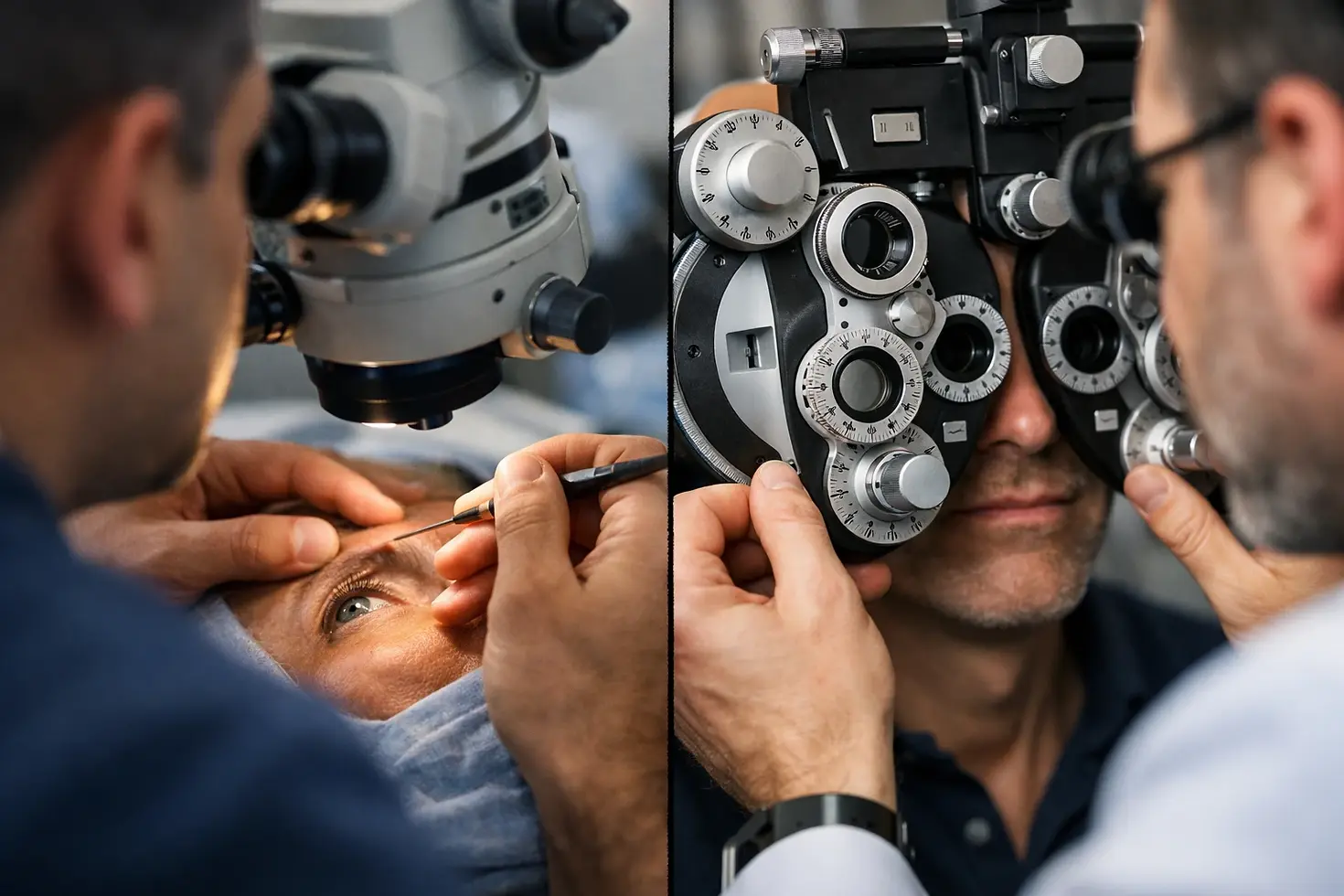
Ophthalmologist vs Optometrist: Which Wins?
- May 21
- 7 min read
Table of Contents
At 7:10 a.m., a grain farmer outside Dubbo sits in a regional clinic waiting room, covers his left eye, and notices the blur stays put. The eye chart on the wall is still there. The tractor dashboard he read clearly yesterday is not. Now he has to decide whether a local vision check is enough or whether the trip to a city specialist cannot wait.
That is where the ophthalmologist vs optometrist question stops being a search term and becomes a care decision. Both professionals help maintain and improve sight. They do not do the same work. One is your front line for routine vision care and corrective lenses; the other handles medical eye disease, surgery, and the problems that can threaten sight quickly.
What Are We Comparing in Ophthalmologist vs Optometrist?
Why this is not just a labels question
Most people ask this when something practical is happening: blurry vision, new floaters, worsening night glare, a contact lens issue, or a referral for possible surgery. You are not choosing a title for its own sake. You are choosing the right scope of care. Optometrists focus on primary eye health. Ophthalmologists treat medical and surgical issues with the eyes. Both matter. They simply sit at different points in the care pathway.
The question is not which doctor is better; it is which doctor matches the complexity of the problem.
How the distinction matters for cataracts and retinal disease
This becomes sharper when cataracts or retinal disease enter the picture. If headlights now burst into halos on the M7, colours look washed out, and night driving feels risky, cataract moves higher on the list. If straight lines bend, a dark patch appears in central vision, or you suddenly see flashes and a shower of floaters, retinal disease becomes a real concern. Those problems do not belong on the same timetable as a routine prescription check.
How to use this guide to choose the right first appointment
Use a simple filter. If you need an exam, a glasses update, contact lens advice, or a first assessment of a mild symptom, optometry is often the right first stop. If the problem already looks medical, urgent, or possibly surgical, ophthalmology is the better lane. That practical split matters even more if you live in Canberra, Liverpool, Randwick, the Hills district, or a smaller regional town where every referral and travel day counts.
Overview of an Optometrist
Training and credentials
Patient education guides commonly describe optometrists as completing four years of professional training after college to earn a Doctor of Optometry, or OD, degree. They are also expected to complete continuing education each year. The exact credential letters vary by country, but the role you meet in clinic is consistent: primary eye care, vision testing, and early detection of eye problems.
Services optometrists provide
This is front-line eye care. Optometrists perform routine eye exams and vision tests, prescribe glasses and contact lenses, and may prescribe certain medications within their scope. They also diagnose and treat many common eye conditions and can detect early signs of more serious disease before you have obvious symptoms.
Routine eye examinations
Glasses and contact lens prescriptions
Vision testing for blurred sight or reading difficulty
Assessment of common problems such as dry eye or eye irritation
Detection of early signs that may need specialist review
Where an optometrist’s role ends and referral begins
The handover point is scope. Once care moves beyond routine vision correction into complex medical treatment or surgery, referral becomes necessary. A cataract that is affecting driving, a retinal tear that needs urgent treatment, or one-sided distortion that suggests macular disease all sit outside routine optometry. In rural and regional communities, though, a local optometrist is often the fastest and most accessible entry point into the system — and a very effective one when referral is made promptly.
Think of an optometrist as the primary care doctor for your eyes.
Overview of an Ophthalmologist
Training and medical background
Ophthalmologists complete medical school, then a one-year internship and a three-year residency in ophthalmology. They also continue with ongoing education. Again, the exact Australian credential pathway differs from the standard US patient-education wording, but the core distinction does not: an ophthalmologist is a medically trained eye specialist who can diagnose disease, prescribe treatment, and perform surgery.
What ophthalmologists treat
Ophthalmology covers medical and surgical issues with the eyes. That includes cataracts, retinal tears, retinal detachment, diabetic eye disease, age-related macular degeneration, inflammatory eye disease, and many other conditions that need specialist treatment decisions. When scans, laser treatment, injections, or surgery may be part of the plan, you are no longer in routine vision-care territory.
Why complexity changes the referral decision
Complexity changes everything because the next step may involve more than a diagnosis. It may involve planning a procedure, reviewing eye imaging, or acting quickly to protect sight. For patients weighing cataract surgery or retinal treatment in Canberra, Liverpool, Randwick, or the Hills district, an ophthalmologist such as Dr Rahul Dubey is the correct lane because diagnosis, treatment, and surgery can be managed within one specialist pathway. That matters when time is short and the problem is not likely to resolve with a new pair of glasses.
If the problem may need surgery or specialist medical management, start where that care can actually happen.
Side-by-Side Comparison Table
Training and credentials
Training is not trivia here. It defines what each clinician can safely assess, prescribe, monitor, and treat.
What each doctor does day to day
One works mainly in primary eye care and vision correction. The other manages eye disease and surgical care. There is overlap in detection. There is not overlap in surgical scope.
Which type of eye problem usually fits each one
Use the table below as a booking guide. It is not a hierarchy. It is a scope map.
The cleanest comparison is scope: one is primary eye care, the other is specialist medical and surgical care.
When to Choose an Optometrist
Routine vision care and new glasses or contacts
If your main issue is seeing less clearly at distance, struggling with near print, needing a new contact lens prescription, or booking your regular eye check, start with an optometrist. That is exactly what the service is built for. You can usually get in faster, stay closer to home, and have the basic question answered early: is this a glasses problem, or is it something more?
Mild symptoms that need an exam first
A local optometrist also makes sense when symptoms are new but not clearly urgent or surgical. Think gradual blur, eye strain after screen work, mild irritation, contact lens discomfort, or a change you have noticed over weeks rather than hours. The value here is triage. Optometrists can examine the eye, test vision, and pick up signs that suggest the problem is not routine after all.
Monitoring stable eye concerns before specialist referral
For many people in regional areas, this is the practical first step. A stable vision issue may be monitored locally while the question of referral is clarified. If the exam shows early cataract, diabetic changes, or another sign that needs specialist review, the optometrist can direct you onward with clearer information.
You need a routine eye exam or prescription update.
You want glasses or contact lenses.
You have mild symptoms that need a first look.
You live in a rural or regional area and need the quickest local access point.
You need someone to decide whether specialist referral is necessary.
If you need an exam, a prescription, or a first look at a symptom, optometry is often the fastest starting point.
When to Choose an Ophthalmologist
Cataracts and retinal conditions
If cataracts or retinal disease are already in the frame, book ophthalmology. Cataracts often show up as glare, faded colours, reduced contrast, and worse night driving. Retinal conditions may present with flashes, floaters, distortion, missing patches of vision, or a fast drop in sight. These are not just testing problems. They are treatment problems, and treatment planning belongs with the specialist who can manage or operate.
Vision changes that suggest medical or surgical disease
Choose an ophthalmologist when the story sounds medical rather than optical. Sudden blur in one eye. Distortion when reading. A rapid fall in vision. Bleeding or inflammation inside the eye. Diabetes-related retinal concerns. A need to discuss surgery. People considering surgical options are squarely in ophthalmology territory, because the same clinician can diagnose the disease, explain the choices, and carry out the procedure if needed.
When a referral should not be delayed
Some symptoms should move you past a routine booking queue. If you are in a regional town two or three hours from the nearest specialist centre, the distance does not make the symptom less urgent. It means the referral should start sooner. If vision has fallen suddenly or you suspect a retinal problem, ask for same-day advice. If the loss is severe, painful, or follows injury, emergency care may also be appropriate.
Sudden flashes and many new floaters
A shadow or curtain across your vision
Distorted central vision or bent lines
Rapid loss of sight in one eye
Significant eye injury
Severe eye pain with reduced vision
Cataract symptoms serious enough to affect safety, driving, or daily function
If the eye problem is likely to need a procedure, imaging-led workup, or surgical treatment, choose ophthalmology.
What to Do Next
The simplest decision rule
Here is the winner in ophthalmologist vs optometrist: the clinician whose training fits the problem. Routine vision care starts with optometry; cataracts, retinal disease, and likely procedures belong with ophthalmology.
Best rule of thumb: routine vision or mild symptoms start with optometry; cataracts, retinal disease, or anything possibly surgical goes to ophthalmology.
What to do if you live far from specialty care
If you live in a regional town, start locally when needed, but ask one direct question: do I need a specialist now, or can this safely wait?
How to ask for the right appointment
When you book, say when the change started, whether one eye is affected, and how fast it is worsening. Which appointment would protect your sight sooner?
Comments