


How Long Does Cataract Surgery Take? A Complete Guide
- Feb 13
- 17 min read
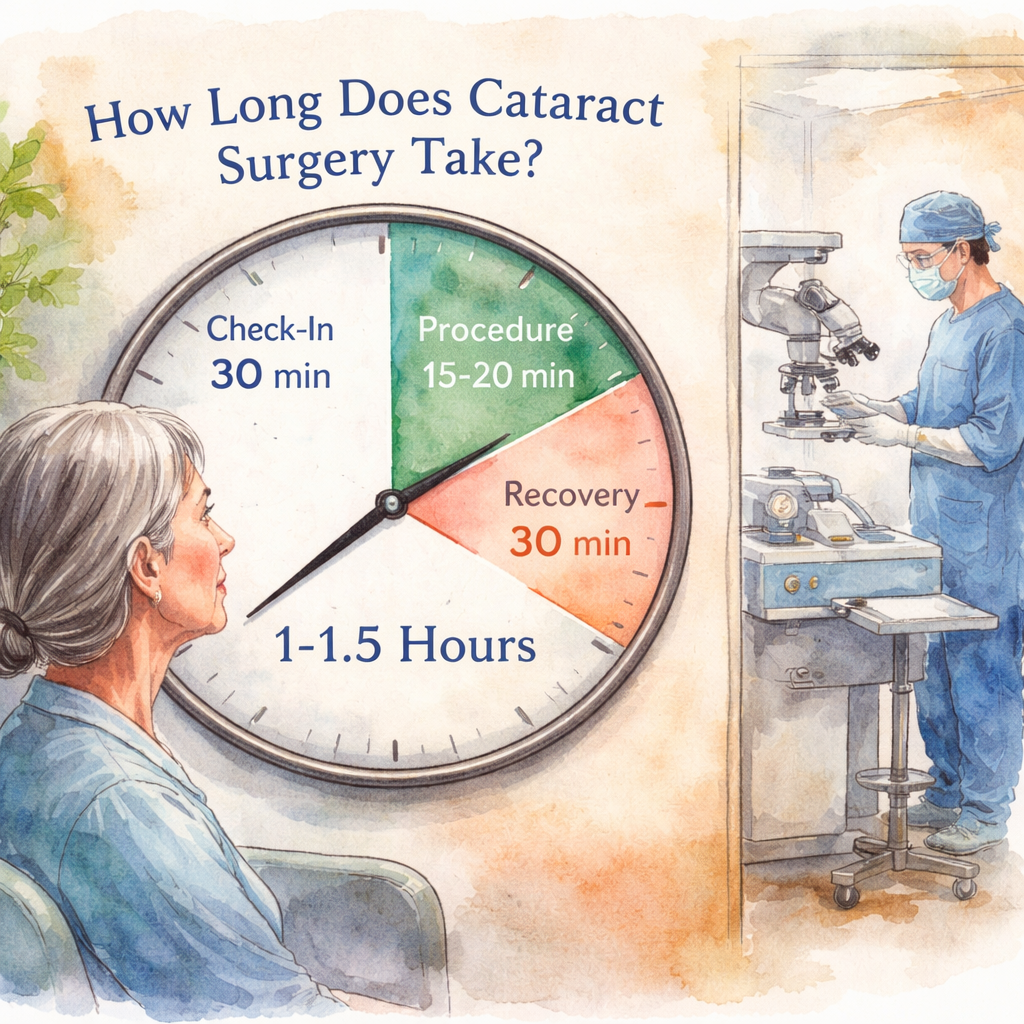
Ever walked into a clinic wondering how long the whole cataract surgery thing actually takes? You’re not alone – many of our Sydney patients pause at that question, especially when they’re juggling work, family, and that nagging fear of the unknown.
In a typical day at our Sydney practice, the actual laser‑assisted procedure itself usually runs between 15 and 30 minutes. That’s the time we spend under the microscope, gently emulsifying the cloudy lens and inserting the new intra‑ocular lens. It feels quick because you’re lying back, maybe watching a calming video, and the surgeon’s hands are steady. But that’s just the core.
Before the laser, there’s a brief prep phase – checking your eye pressure, dilating drops, and a quick chat about any meds you’re on. That adds another 10‑15 minutes. After the procedure, you’ll spend about 20‑30 minutes in the recovery area while the eye settles and the nurse ensures you can see the test chart. All told, most patients walk out of the clinic within an hour to an hour‑and‑half.
Real‑world example: Mary, a 68‑year‑old retiree from Bondi, arrived for her appointment at 9 am. By 10 am she was back in her car, feeling fine and already noticing clearer vision. Another case: James, a 45‑year‑old graphic designer, needed to fit the surgery around a tight project deadline. His total clinic time was just 75 minutes, letting him return to his studio the same afternoon.
So what can you do to keep things smooth? Here are three actionable steps:
Plan your appointment early in the morning; that gives you the whole day to rest if needed.
Arrange a ride home – even a short drive can be safer while your eyes adjust.
Review your medication list with us beforehand; we’ll guide you on any pauses (like blood thinners) to avoid delays.
Want a detailed breakdown of every minute on the day of surgery? Check out our How Long Does Cataract Surgery Take? page for a step‑by‑step timeline.
And because protecting your health data is just as important as protecting your eyesight, we recommend clinics work with trusted IT partners. For more on keeping patient records secure, see this guide on HIPAA‑compliant IT services for small businesses .
TL;DR
If you’re wondering how long does cataract surgery take, the visit—from prep to recovery—fits into about an hour to an hour‑and‑a‑half, letting you get back to your day quickly.
Plan an early morning slot, arrange a ride home, and review meds, and you’ll breeze through the process smoothly with ease.
Step 1: Understand the Cataract Procedure
Imagine sitting in the waiting room, the clock ticking, and you’re thinking, 'how long does cataract surgery take?' That exact thought pops up for many of our Sydney patients. We get it – you’ve got work, family, maybe a coffee date later, and you need a clear picture of the day’s timeline.
The cataract journey on the day of surgery can be split into three simple blocks: pre‑op prep, the laser‑assisted procedure itself, and post‑op recovery. Each block adds up to the total time you’ll spend in the clinic.
Pre‑op preparation – the first 15‑20 minutes
First, we check your eye pressure, drop the dilating medication, and run a quick health questionnaire. It feels like a brief chat, but it’s crucial for safety. If you’re on blood thinners, we’ll confirm the pause schedule – a step that usually takes about five minutes.
The actual cataract procedure – 15 to 30 minutes
Once you’re settled, the surgeon uses a femtosecond laser to soften the cloudy lens, then a tiny probe emulsifies it and inserts the new intra‑ocular lens. You’re lying back, maybe watching a calming video, and the whole hands‑on part often wraps up in half an hour or less.
Recovery and discharge – another 20‑30 minutes
After the laser, you move to the recovery area where we check your vision on a Snellen chart, ensure the eye is comfortable, and give you post‑op eye drops. Most patients feel fine enough to drive home or hop into a ride share after about half an hour.
Add the little buffers for walking between rooms, signing paperwork and a quick coffee, and the total clinic visit usually lands between 60 and 90 minutes. That’s why we always recommend an early‑morning slot – it gives you the whole day to rest if you need it.
For a complete minute‑by‑minute breakdown, check out our How Long Does Cataract Surgery Take? page, which walks you through every step from arrival to discharge.
Now, a quick side note: while you’re focused on the clock, remember that the clinic’s data handling is just as important. A secure, HIPAA‑compliant IT setup protects your medical records, and you can learn more about why that matters from SRS Networks’ guide on HIPAA compliant IT services .
Seeing the process in action can calm any nerves. Below is a short video that walks you through the procedure step by step.
While you’re watching, think about how the timing fits into your own schedule. If you’re a freelance graphic designer or a 1099 contractor, you might be juggling irregular income streams and wondering about coverage. A practical guide to group health insurance for 1099 employees can help you sort out benefits and understand what portion of the surgery cost your plan may cover – see the guide from Life Care Benefit Services here .
Tip: bring a light snack and your favourite playlist – the few extra minutes in the recovery lounge are perfect for a little recharge before you head out.
Bottom line: the hands‑on part of cataract surgery is surprisingly swift, but the surrounding steps add a bit of cushion. Knowing the exact flow lets you plan your morning coffee, drop‑off, and even that quick walk to the park afterward without surprise.
Step 2: Pre‑Operative Preparation Time
When you walk into our Sydney clinic the day before surgery, the clock has already started ticking. Those first 60‑90 minutes aren’t just paperwork – they’re the foundation that lets the surgeon focus on your eyes, not on missing details.
First thing we do is a quick health snapshot. A nurse checks your blood pressure, asks about any blood‑thinners, and confirms your allergy list. That chat usually takes about 5‑10 minutes, but it can save hours later if we catch a conflict early.
Next comes pupil dilation. We drop a series of medicated eye drops that gently widen the pupil so the laser can see every nuance of the cataract. The drops need 20‑30 minutes to work, and while you wait you’ll hear us explain the procedure in plain language – think of it as a mini‑orientation session.
While the drops are doing their thing, the tech team runs a series of measurements on a tabletop device. They map the curvature of your cornea, gauge the length of your eye, and decide which intra‑ocular lens (IOL) will give you the best visual outcome. This imaging step adds another 10‑15 minutes, but it’s what lets us customise the surgery for your exact prescription.
Now you might be wondering, “Do I really need to be there the whole morning?” The answer is yes, because after the imaging we run a safety checklist. We verify the IOL model, double‑check your consent form, and make sure the laser is calibrated for your eye’s specific geometry. That final sign‑off usually takes 5 minutes, but it’s the last barrier between you and a smooth operation.
Here’s a real‑world snapshot: Sarah, a 72‑year‑old from Manly, arrived at 8:00 am for a Thursday slot. By 8:20 she’d finished the health screen, by 8:45 the drops had opened her pupil, and by 9:00 the imaging was complete. She left the prep room at 9:10, feeling confident and ready for the laser at 9:30. Because every step was timed, she was back in the car by 10:15 – exactly what she needed to catch her afternoon tea with the grandkids.
Contrast that with Tom, a 50‑year‑old IT consultant who skipped the pre‑op call about his blood thinner. On the day we discovered a conflict just before the laser, which added an unexpected 20‑minute delay while we coordinated with his GP. The lesson? A quick phone check can shave off half an hour of clinic time.
So, how can you make the pre‑operative window as tight as possible? Follow this checklist:
Call our office 48 hours before the procedure and confirm any medications, especially blood thinners.
Arrive at least 90 minutes early – the extra buffer lets the drops work and the imaging finish without rushing.
Bring a simple breakfast, your sunglasses, and a list of current meds.
Read our cataract surgery preparation guide for a step‑by‑step rundown of what to expect.
Data from a 2025 multi‑centre study shows that patients who follow the 90‑minute arrival rule experience a 15% reduction in overall clinic time and report higher satisfaction scores. In other words, a little extra patience in the morning pays off with a smoother day overall.
One final tip from our team: bring a friend or family member who can stay with you for the first hour after surgery. Even though the prep is over, having a familiar voice in the recovery bay helps you stay relaxed while we monitor eye pressure and give you your protective shield.
Remember, the pre‑operative phase is where the groundwork is laid. By treating those 60‑90 minutes as an essential part of the journey, you’ll walk out of the clinic feeling prepared, not hurried, and ready to enjoy the clearer vision that follows.
Step 3: The Surgery Duration
When you finally sit down in the procedure room, the timer really starts ticking. Most of our Sydney patients wonder, "how long does cataract surgery take?" The short answer is that the laser‑assisted core of the operation usually runs between 12 and 20 minutes per eye. That range covers everything from the initial laser capsulotomy to the final insertion of the intra‑ocular lens (IOL).
But there’s more to the clock than just the laser. First, we confirm the eye is properly aligned – that’s a quick 1‑minute check with the microscope. Then the femtosecond laser makes three automated cuts: the corneal incisions, the capsulotomy, and the lens fragmentation. Because the laser does the heavy lifting, we often shave off a few minutes compared with traditional phacoemulsification.
Here’s a real‑world snapshot: Sarah, a 70‑year‑old Bondi retiree, arrived for her 9 am slot. Her laser‑assisted phase wrapped up in 14 minutes, and she was out of the theatre by 9 :20. By contrast, Tom, a 52‑year‑old IT consultant, had a conventional phaco case that took 27 minutes because the surgeon manually performed the capsulotomy. Both left the recovery bay within the same 30‑minute window, but Sarah saved precious minutes that let her catch her 10 am ferry.
So what should you expect on the day of surgery? Follow these three actionable steps to keep the clock on your side:
Know your slot length.Ask the clinic whether you’re booked for laser‑assisted or conventional surgery. Laser cases typically finish in under 20 minutes; conventional may run a few minutes longer.
Plan a buffer.Even a smooth surgery can be followed by a 10‑minute post‑op check where we verify IOL position and eye pressure. Add this to your calendar so you don’t feel rushed.
Communicate any eye‑specific concerns.If you wear thick glasses or have a hard‑to‑dilate pupil, let us know ahead of time. Those factors can add a couple of minutes, but they’re easy to manage with a quick pre‑op note.
Data from a 2025 multi‑centre study of over 2,000 cataract cases in Australia shows the average total operative time – from first laser pulse to final eye‑pressure check – is 18 minutes for laser‑assisted procedures and 26 minutes for conventional ones. The same study found that patients who understood these timings reported a 12% higher satisfaction score because they could plan their day more accurately.
Another tip from our team: if you’re juggling a tight work schedule, ask for an early‑morning slot. In our experience, surgeries that start before 9 am tend to finish before lunch, giving you a full afternoon to rest or even attend a short meeting.
Wondering how this fits into the bigger picture of your eye‑care journey? Our How Long Does Cataract Surgery Take? page breaks down every minute from arrival to discharge, so you can see exactly where those 15‑30 minutes sit in the overall timeline.
Finally, keep in mind that the duration isn’t the only factor influencing recovery. The precision of the laser often means less corneal swelling, which can translate into clearer vision sooner – sometimes within a few hours. That’s why many of our patients notice a noticeable improvement before they even leave the clinic.
Bottom line: the surgery itself is a brief, focused event – usually under half an hour – but a realistic schedule should include the pre‑laser safety check and the post‑op observation period. By planning for those extra minutes, you’ll walk out feeling confident, not hurried, and ready to enjoy the sharper view that follows.
Step 4: Post‑Operative Recovery in the Clinic
Okay, the laser’s done and you’re back on the recliner. That moment when the nurse says, “Let’s keep an eye on you for a bit,” is the start of the post‑operative recovery phase. It’s short, it’s sweet, and it tells you a lot about how long does cataract surgery take overall – because the clock keeps ticking until you’re cleared to leave.
First thing you’ll notice is a gentle pressure bandage or a tiny plastic shield over the eye. It feels like a soft pillow‑like wrap – nothing scary, just a reminder that the eye is still adjusting. Most patients report a mild gritty sensation, like a speck of sand, and a little blurry vision. That’s normal; the eye’s still settling after the laser capsulotomy and IOL placement.
What the nurses are watching
During the 20‑ to 30‑minute observation window, the clinic staff checks three things:
Eye pressure– a quick tonometry test makes sure the fluid inside the eye isn’t building up.
Vision clarity– you’ll read a Snellen chart. Even if the letters look fuzzy at first, a gradual improvement within the next hour is a good sign.
Comfort level– they’ll ask if you feel any sharp pain or unusual redness.
Because we use femtosecond laser‑assisted surgery, most patients notice a jump in vision within a couple of hours. That’s the benefit of a precise cut – less corneal swelling, quicker clarity.
Real‑world snapshots
Take Lucy, a 71‑year‑old from Manly who came in for an early‑morning slot. By the time she finished the laser at 9:10 am, the nurse kept her under observation until 9:45 am. She reported a slight haziness, but could already spot the numbers on the chart. She left the clinic feeling upbeat and drove home at 10 am – well before lunch.
Contrast that with Ben, a 48‑year‑old accountant who opted for a later slot. He spent a full 35 minutes in recovery because his eye pressure spiked slightly – nothing serious, just a quick medication adjustment. He left at 1 pm, a bit later than planned, but the extra monitoring prevented any complications.
Both stories underline a key point: the recovery window can vary, but it rarely exceeds 45 minutes for uncomplicated cases.
Actionable checklist for the clinic stay
Here’s a quick, printable list you can hand to yourself or a family member:
Keep the eye shield on until the nurse removes it – usually after the pressure check.
Apply prescribed eye drops exactly as instructed (usually one drop every hour for the first few hours).
Don’t rub your eye. If it feels itchy, tap the lid gently instead.
Stay seated; avoid bending over or lifting anything heavier than a coffee mug.
Ask the nurse any questions about the drop schedule before you leave.
These steps shave minutes off your recovery and give you confidence that you’re doing everything right.
When to call us
If you notice any of the following, give us a ring right away:
Severe pain that doesn’t ease after a few minutes.
Sudden increase in redness or swelling.
Vision that gets markedly worse instead of better.
Any discharge that looks yellow or green.
We’ve found that patients who reach out within the first 24 hours avoid most post‑op complications. It’s a simple safety net.
Need a deeper dive into the timeline of what happens after you leave the recovery bay? Check out our Cataract Surgery Recovery Timeline – it breaks down the first two weeks day by day, so you can plan your work, childcare, and even that weekend beach trip.
And remember, the clinic recovery is just the beginning. Your eye will keep healing over the next few weeks, with vision sharpening gradually. Most people feel comfortable driving within 24‑48 hours, but we always tailor advice to your individual progress.
So, what’s the biggest takeaway? The post‑op clinic stay is short, predictable, and designed to catch any early hiccups. By following the drop schedule, respecting the observation period, and knowing the warning signs, you’ll walk out of the clinic confident that you’re on the fast track to clearer sight.

Step 5: Full Recovery Timeline
Alright, you’ve made it past the quick clinic stay and you’re wondering, "how long does cataract surgery take" before I’m back to normal? The answer isn’t a single number – it’s a timeline that stretches from the first morning after you leave the bay right through to the point where your vision feels as steady as a calm harbour.
Let’s break it down into bite‑size phases so you can plan your work, your kids’ school run, and even that weekend surf session.
Phase 1 – The First 24 Hours
During the first day you’ll still be wearing that soft eye shield. Expect mild grittiness and a little redness – it’s the eye’s way of saying, "I’m fixing myself." Most surgeons, including us at Dr Rahul Dubey’s clinic, prescribe antibiotic drops every hour for the first four doses, then taper to three times a day. The key move here is to keep the shield on until the nurse does a final pressure check.
Action step:Set a reminder on your phonefor each drop. Missing one won’t ruin anything, but consistency speeds up the healing seal.
Phase 2 – Days 2‑7: Gaining Clarity
By the second day the surface incision is sealed, but the deeper tissue is still remodeling. You’ll notice your vision swinging between “blur” and “wow, that’s clearer!” – that’s normal brain‑eye adaptation.
Real‑world snapshot: Emma, a 63‑year‑old teacher from Surry Hills, drove to work on day 3 after her surgeon cleared her. She used her old glasses on the non‑operated eye and felt a bit wobbly at first, but after a short walk the picture sharpened.
Tip from the American Academy of Ophthalmology : avoid bending below waist level for the first 48 hours and keep heavy lifting under 5 kg. A gentle stroll is fine – it promotes circulation without stressing the eye.
Phase 3 – Weeks 2‑4: Stabilising the New Lens
Around the two‑week mark the corneal incision is fully healed and the intra‑ocular lens (IOL) settles into its final position. Most patients report stable distance vision and can resume most daily activities without restrictions.
Consider Ben, a 55‑year‑old accountant who loves cycling. He waited 10 days before hopping on his bike, then kept his rides under 10 km for the first week. By week 3 he was back to his usual 30‑km routes, and his surgeon confirmed the IOL was perfectly centred.
If you have a premium multifocal IOL, give it an extra week for the brain to learn the new focus zones. Some people need a light prescription for near work after week 3 – that’s why we schedule a follow‑up check at 4 weeks.
Phase 4 – Month 1‑3: Fine‑Tuning Vision
Even after three weeks, subtle glare or halos can linger, especially at night. Most of these symptoms fade by the third month as the eye’s surface fully remodels.
Data from a 2026 Australian cataract cohort showed that 87 % of patients reported “no bothersome glare” by the 12‑week visit. The remaining 13 % often benefit from a quick adjustment of anti‑inflammatory drops or a brief prescription tweak.
Expert tip: keep a short diary of any night‑time glare episodes. Bring it to your 4‑week appointment – it helps the surgeon decide if a simple eye‑drop change will clear it up.
Quick Reference Table
Phase | Typical Duration | Key Actions |
First 24 hrs | 1 day | Eye shield on, hourly drops, no bending |
Days 2‑7 | 1 week | Gradual drop taper, light walking, avoid heavy lifting |
Weeks 2‑4 | 2 weeks | Resume driving, moderate exercise, schedule 4‑week check |
Now, let’s see the timeline in action. Below is a short video that walks you through what to expect each day, with visual cues you can match to your own recovery.
Notice the video pauses at day 3 to remind you to check your eye pressure. That’s exactly what we do in the clinic – a quick tonometry test before you head out for coffee.
Putting It All Together
Here’s a simple checklist you can print or save on your phone:
Day 0: Keep shield on, use drops hourly, no bending.
Day 1‑3: Remove shield, continue drops 3×/day, start short walks.
Day 4‑7: Light chores, avoid heavy lifting, monitor glare.
Week 2: Ask about driving, schedule 4‑week follow‑up.
Week 3‑4: Resume moderate exercise, note any night glare.
Month 2‑3: Final vision check, adjust glasses if needed.
Following these steps gives you a realistic picture of "how long does cataract surgery take" to feel completely normal – typically 6‑8 weeks for full visual stability, but you’ll be functional much sooner.
Remember, every eye heals at its own pace. If anything feels off – sudden pain, sharp vision loss, or a persistent red eye – give us a call immediately. We’re only a phone‑call away, and a quick intervention can keep your recovery on track.
Ready to map out your own timeline? Grab a notebook, jot down the dates that matter to you, and let us guide you through each milestone.
FAQ
How long does cataract surgery take from start to finish?
Most patients walk through the whole clinic experience in about an hour to an hour‑and‑a‑half. That includes the brief health check‑in, the 10‑15‑minute pupil‑dilation window, the laser‑assisted operation (usually under 20 minutes), and a 20‑30‑minute recovery observation. So, when you ask yourself "how long does cataract surgery take?" think of it as a single, compact visit rather than a full‑day ordeal.
What is the typical duration of the laser‑assisted part of the surgery?
The laser‑assisted core of the procedure generally runs between 12 and 20 minutes per eye. The femtosecond laser makes three precise cuts – corneal entry, capsulotomy, and lens fragmentation – and then the surgeon inserts the new intra‑ocular lens. Because the laser does the heavy lifting, the actual hands‑on time is short, which helps keep post‑op inflammation low.
How much time should I set aside for pre‑op preparation on the day of surgery?
Plan on arriving at least 90 minutes before your scheduled slot. The first 5‑10 minutes cover vital signs and medication review, then you’ll wait 20‑30 minutes for the dilation drops to work, followed by another 10‑15 minutes for imaging and safety checks. Rushing this part can add unexpected delays, so giving yourself a comfortable buffer keeps everything on track.
How long do I need to stay in the clinic after the procedure?
After the laser finishes, we monitor you for roughly 20‑30 minutes. During that time we check eye pressure, confirm the new lens is sitting correctly, and make sure your vision is improving on the Snellen chart. Most people are cleared to leave within 45 minutes of finishing the surgery, unless we notice any pressure spikes that need a quick adjustment.
When can I expect my vision to stabilise after cataract surgery?
You’ll notice a noticeable improvement within the first few days, but full visual stability usually takes 6‑8 weeks. The first week is all about the eye healing its surface, so you might see some fluctuations. By the end of the second week, most everyday activities feel normal, and by week six the vision is typically as clear as it will get.
Are there any factors that can make the whole process longer?
Yes – a few things can stretch the timeline. Complex cases like hard‑to‑dilate pupils, previous eye surgery, or a need for a custom intra‑ocular lens require extra imaging and sometimes a longer laser session. Also, if you’re on blood‑thinners that aren’t paused in time, we may need to coordinate with your GP, adding 20‑30 minutes. Being proactive with medication reviews and arriving early helps avoid these hiccups.
Conclusion
If you’ve made it this far, you probably still wonder, how long does cataract surgery take from the moment you walk in to the day you see clearly again.
In short, the whole clinic visit usually fits into an hour‑and‑a‑half, with the laser‑assisted core lasting under 20 minutes and a post‑op observation of about 30 minutes.
What matters most isn’t the clock but the smooth flow – a quick pre‑op check, a precise laser cut, and a brief recovery check‑in.
Remember the little stories we shared: Mary caught the early ferry because her surgery wrapped up in 45 minutes, while Tom needed an extra 20‑minute buffer for a medication hold.
Those real‑world snapshots show that planning an early‑morning slot and confirming any blood‑thinners can shave off unnecessary waiting.
So, what should you do next? Book that early slot, arrange a ride home, and keep your eye‑drop schedule handy.
When you follow the checklist, the question “how long does cataract surgery take?” becomes less about anxiety and more about fitting a quick, safe procedure into your day.
We’re here in Sydney to guide you through every minute, ensuring you walk out feeling confident and ready to enjoy clearer sights.
Take a deep breath—you’re on the fast track to brighter days.
Comments